The Hands That Remember
On muscle memory, craft, and the wisdom stored in our fingers
Tuesday, August 18, 2026
My grandmother could not tell you her own address by the end. She could not tell you the year or the president or whether she had eaten lunch. But her hands could still fold a fitted sheet.
I want you to sit with that for a moment. The mind, that vast and shimmering architecture of language and memory and self, had crumbled in significant ways. And the hands, those modest and uncomplaining servants, still knew exactly what to do with a fitted sheet. They gathered the corners. They tucked and smoothed and folded with a precision that would have made a laundress weep with envy. And when the sheet lay flat and neat on the bed, her hands rested on it for a moment, satisfied, as though they had just completed a sonata.
The Intelligence of the Hands
We live in a culture that has placed its faith in the brain. We measure intelligence by what we can articulate, remember, compute, explain. We treat the body as a vehicle for the mind, a meat suit that carries the important parts from room to room. But anyone who has watched a body remember what a mind has forgotten knows this hierarchy is a lie.
The hands have their own memory. It is not stored in words or images but in the particular curl of fingers around a familiar handle, in the angle of the wrist when it knows a knife is coming, in the pressure of a thumb on dough that has reached the right consistency. This memory does not decline the way declarative memory does. It is stubborn. It is embodied. It lives in the muscle fibers themselves, in the neural pathways that loop between hand and spinal cord without bothering to check with the brain.
My grandmother's hands knew how to fold a sheet. They also knew how to shuck corn, how to test the temperature of an iron by hovering a palm above it, how to tell when bread was done by tapping the crust and listening. They knew how to crochet, how to garden, how to write her name in a script so particular and so steady that even in confusion, her signature was unmistakably hers.
Craft as Continuity
Craft is not just about making things. Craft is about the relationship between the body and the material world, the ongoing conversation between hands and wood and thread and flour and soil. When we lose that conversation, we lose something essential: a way of knowing that does not depend on words.
In caregiving, this becomes a kind of lifeline. When my grandmother could no longer tell stories, she could still knit. When she could no longer follow a recipe, she could still knead bread. The craft was the last door to close, and it stayed open long after the others had shut, letting in a thin beam of the person she had always been.
I think about this when I am tempted to skip the slow work. The chopping by hand instead of the food processor. The letter written in pen instead of typed. The bread kneaded on the counter instead of the machine. These are not nostalgic gestures. They are acts of deposit, investments in a memory that lives in the body, a memory that may outlast every other kind.
What the Hands Carry Forward
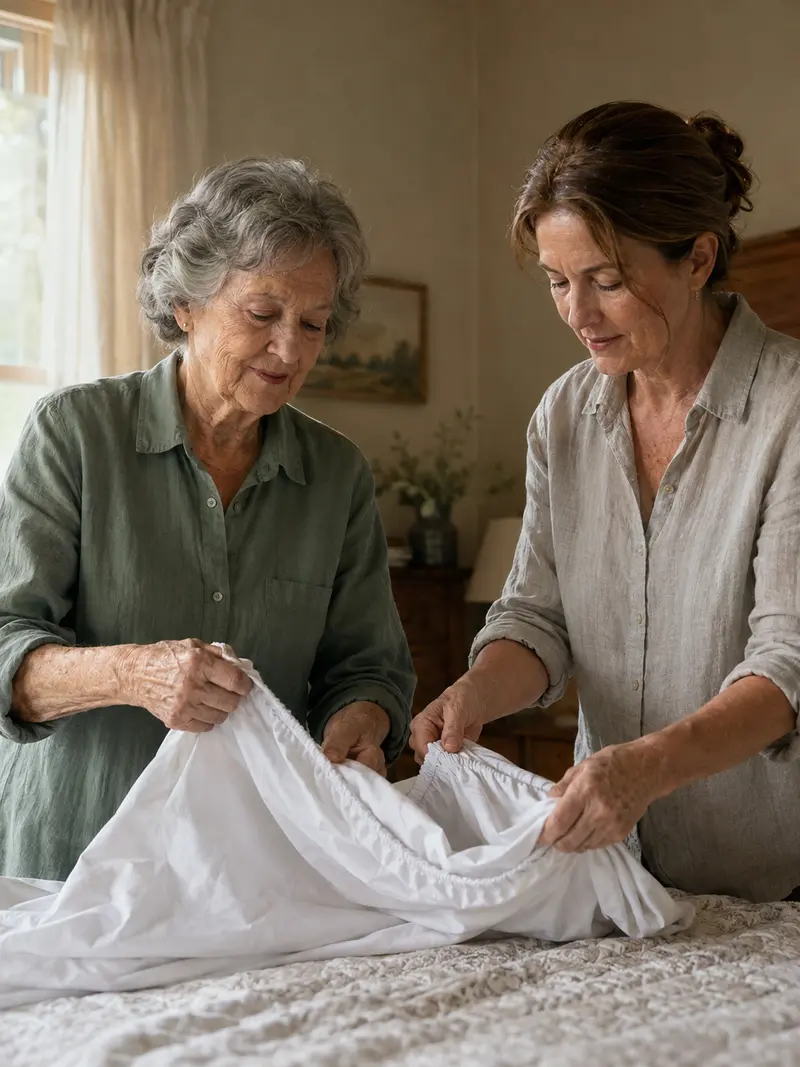
My mother learned to fold a fitted sheet from her mother. She practiced it in her own home for decades before she ever needed to, and by the time she was caring for my grandmother, her hands knew the motion as well as their own pulse. Sometimes they would fold together, my grandmother's hands and my mother's hands, working the same sheet, and for a moment the line between them would dissolve. Two sets of hands, two generations of knowing, moving in the same ancient pattern.
This is what craft gives us: a way to be present with each other that does not require conversation. A way to be together that is older than language. When my grandmother's hands were busy, she was calm. She was herself. The anxiety that came with confusion would settle, and there she would be: a woman who knew how to do things with her hands, a woman whose body carried the record of a long and useful life.
I am learning to trust my hands more. To let them find their way without instructions. To let them remember what my mind is too busy to hold. Because one day, if I am lucky, my hands will be the last thing that knows who I am. And on that day, I want them to be able to fold a fitted sheet, to knead a loaf of bread, to write my name in a script that is unmistakably mine.
I want them to remember. And they will, if I let them.
End of Story
"And that is more than enough."
The Revival Manifesto
We believe that love does not forget. It transforms.
We believe that even as memories fade, meaning remains. In the touch of a hand. In a familiar song. In the rituals that carry us forward when words no longer can.
The Revival Haven Chronicles is a gathering place for stories of caregiving, grief, resilience, and renewal. Here, we honor what remains, preserve what matters, and remind one another that no journey is meant to be walked alone.
Receive the next Chronicle entry
Reflections
Be the first to leave a reflection on this Chronicle.