What the Table Remembers
On the artifacts of inheritance and the stories furniture carries
Tuesday, August 25, 2026
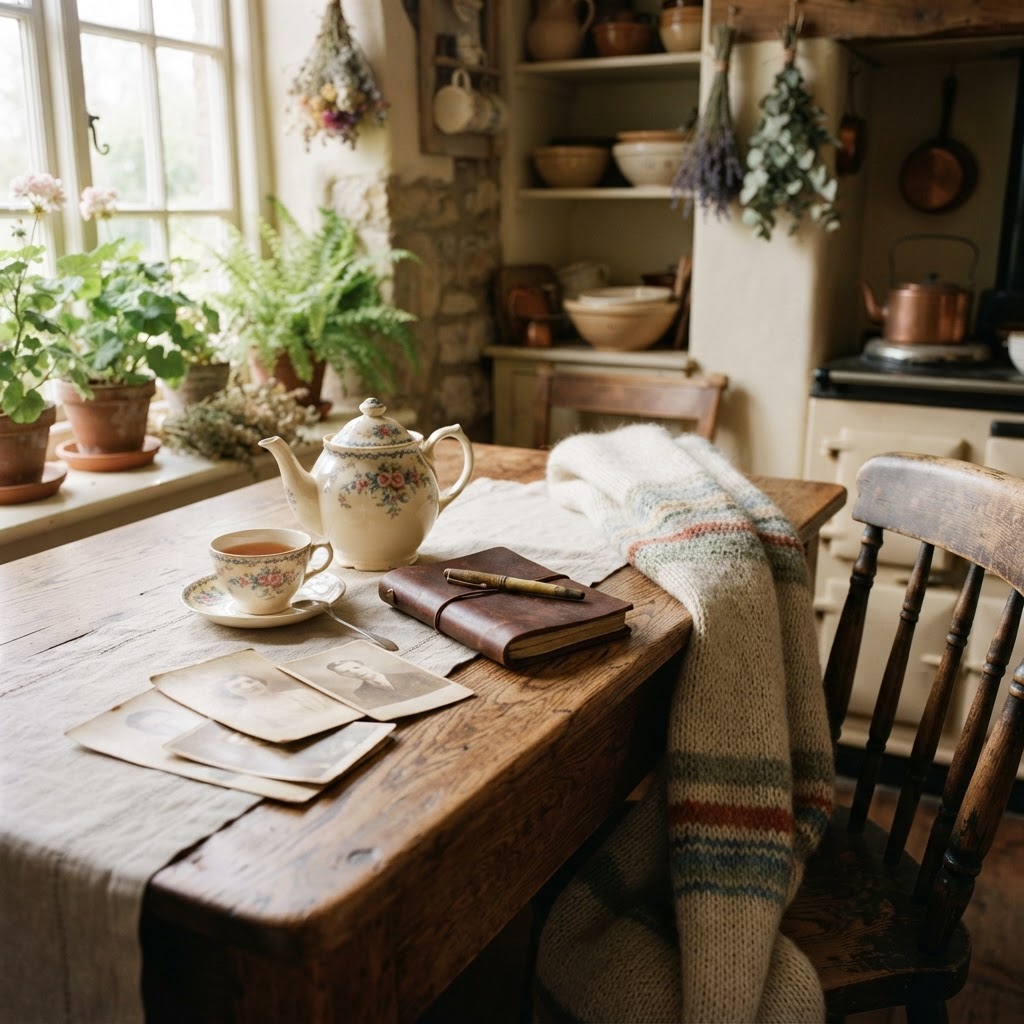
The table is oak, scarred, and older than anyone now living in the house. It has been moved seven times that I know of, maybe more. It has held birthday cakes and tax documents and seedlings started too early in cups on the windowsill above it. It has held silence, which is to say it has held two people eating together who had nothing to say and everything to say and could not find the bridge between.
It is the table where my grandmother set out the good china for holidays, the one where my mother did homework, the one where I learned that a cup of tea could be an act of communion if the person pouring it meant it that way. And now it sits in my kitchen, and when I press my palm flat against its surface, I can feel the grooves where decades of hands have worn the wood smooth.
The Language of Inherited Objects
We inherit many things. Some come in envelopes from attorneys. Some come in the particular tilt of our head when we are listening, or the way we hold a cup with both hands as though it might fly away. And some come in the form of objects: chairs, tables, quilts, teapots, the physical residue of lives lived before ours.
These objects are not neutral. They are not merely functional. They carry the residue of the hands that used them, the meals that were served on them, the conversations that happened around them. When we bring an inherited object into our home, we are not just acquiring furniture. We are adopting a history, a set of associations, a particular weight of meaning that the object has accumulated over years and years of use.
My grandmother's table remembers more than I do. It remembers the Thanksgiving my grandfather carved the turkey too enthusiastically and sent a leg flying across the room. It remembers the morning my mother sat at it with a cup of coffee and a positive pregnancy test she was not sure how to feel about. It remembers the afternoon my grandmother sat at it alone, after the funeral, and ate a piece of toast, which was all she could manage, and then sat there for another hour because the chair was where she always sat and the table was where she always was and some part of her believed that if she just stayed, he would come back.
The Weight We Place on Surfaces
We underestimate how much of our emotional life happens at tables. Tables are where we break bread and break news and break down. They are where we write the difficult letter and sign the important document and hold the hand of the person across from us who is trying to find the words. The table holds all of this, not in any mystical sense, but in the physical sense of being the surface on which it all happened.
When my mother was caring for my grandmother, the table became a kind of headquarters. Medications were organized on it. Appointments were written on the calendar that hung above it. Meals were prepared and served on it, and when my grandmother could no longer eat at the table, the table became the place where my mother sat alone and processed the day, a cup of tea going cold beneath her hands.
She told me once that the table was the only thing in the house that did not feel different. Everything else had changed: the rhythms, the sounds, the smell of the house had shifted as illness moved in and rearranged everything. But the table was still the table. Solid. Scarred. Familiar. It was the one surface she could press her hands against and feel something continuous beneath her palms.
What We Choose to Keep
There is a question that every family faces eventually, usually in the aftermath of loss: what do we keep? The house must be emptied. Decisions must be made. Some objects go to relatives, some to auction, some to the donation pile. And in the sorting, in the holding up of each object and the asking of does this mean something?, we discover what the table has known all along: that meaning is not in the object but in the accumulation of moments the object has witnessed.
I kept the table. I kept the teapot with the chip on the spout. I kept the afghan that smelled of cedar. I kept these things not because they are valuable or beautiful, though some of them are, but because they are the last witnesses to a life I want to remember.
The table sits in my kitchen now. I eat at it. I write at it. Sometimes I just rest my hands on it and feel the grooves and try to listen to what it remembers. It is an old oak table, scarred and worn, and it has held more than I will ever know. That is enough. That is more than enough.
End of Story
"And that is more than enough."
The Revival Manifesto
We believe that love does not forget. It transforms.
We believe that even as memories fade, meaning remains. In the touch of a hand. In a familiar song. In the rituals that carry us forward when words no longer can.
The Revival Haven Chronicles is a gathering place for stories of caregiving, grief, resilience, and renewal. Here, we honor what remains, preserve what matters, and remind one another that no journey is meant to be walked alone.
Receive the next Chronicle entry
Reflections
Be the first to leave a reflection on this Chronicle.